![[personal profile]](https://www.dreamwidth.org/img/silk/identity/user.png) buggery
buggery(I'm actually not home yet, but I'll be posting about all the fun I've been having and my continued not-at-homeness within the next day or three. --Jack)
This is Te typing, but it's really a fully collaborative meta. It's just that I'm on the computer, and Jack is chillin' with comics about eight feet behind me, and really -- I'll be linking this from my LJ soon enough.
So, Jack and I were chatting about various yummy meta things currently floating around (notably this post from![[livejournal.com profile]](https://www.dreamwidth.org/img/external/lj-userinfo.gif) beeblebabe and this particular thread in the comments), musing on the nature of the female voice (and lack thereof) in comics, and how the Women In Refrigerators site really *had* to get that name.
beeblebabe and this particular thread in the comments), musing on the nature of the female voice (and lack thereof) in comics, and how the Women In Refrigerators site really *had* to get that name.
Not just for the recognizability aspects, but for the fact that the infamous (and eponymous) Alex storyline in GL -- and the way Marz himself talks about it -- really *highlights* one of the biggest problems with the way women are used in a lot of comics.
Marz:
All that said, I can tell you Alex was a character destined to die from the moment she was first introduced in GL #48. I created her with the intention of having her be murdered at the hands of Major Force. I took a lot of care in building her as a character, because I wanted her to be liked and her death to mean something to the readers. I wanted readers to be horrified at the crime, and to empathize with Kyle's loss. Her death was meant to bring brutal realization to Kyle that being GL wasn't fun and games. It was also meant to sever his links with his old life, paving the way for his move to New York. And ultimately I wanted her death to be memorable and illustrate just how truly heinous Major Force was. Thus the fridge.
Now, I've talked about this quote a lot over the past several months, and how it pretty much drives me batshit insane, but some things bear repeating. Because really, what Marz is saying here is that Alex wasn't just born to die, but that she was born to die *solely for the purpose* of advancing the character arcs of two male characters. She's there to make us go all woobie-eyed for Kyle and get a nice big hate-on for Major Force. That's just fact.
Less factual is... well. I've *read* a goodly number of Marz's GL issues (hey, I have to have *reason* before I put a writer on my "oh, HELL no" list), and Jack has read a fair if smaller number, and the thing is? Considering the canon and the interviews, it simply isn't beyond the realm of possibility for readers like us to take one look at that quote about the heinousness of Major Force and wonder if we're supposed to hate him because he's a brutal killer or, you know, because he made poor Kyle cry. But that's an aside.
Basically, what we have here is textbook Lingering/Underlying Misogyny. Women who exist not to be characters in their own right -- and certainly not to be *people* -- but to be plot devices.
And this all brought the two of us back to the "War Games" bitterness, because really... Alex died years ago, and the hoopla that exploded over the world of comics after that event went public was over long before most of the people reading *this* post ever picked up a DC comic. It's just that certain people clearly haven't learned anything from it.
Back it up a little bit. We all know how it goes when a character dies in comics, right? Usually, it's someone who, for whatever reason, hasn't gotten to star in any titles for a while. Someone whose last major storyline occurred years before, etc. That character gets a few issues of whichever title(s) are getting the Capital-E-Event in which to shine, garner our sympathies, and wander around having doom-laden conversations with the characters who'll actually survive the violence.
After all -- we, as readers, must be given as many opportunities as possible to think back to the issues before the death in question and think "aw, man, [Surviving Character] will *never* forget that! WOOBIE!"
This is routine. This is how it *goes*.
It's illustrated beautifully in "War Games" with Orpheus. We may never know *why* the guy got shoved into limbo after being introduced in ORPHEUS RISING. (Before Gabrych reintroduces him in DetC, we get to see him hanging out with Dinah in BATMAN: FAMILY and getting blown off by Nightwing during "Murderer." That's... it.) Most people who read War Drums (the trade collecting the DETECTIVE COMICS and ROBIN issues which lead up to "War Games" proper) had never even heard of the guy, but Gabrych played his part in this neverending dance of character death quite well.
Readers got to see him, hang out with him, watch him fight crime, watch him be cute with Onyx, watch him interact with Batman -- the whole nine yards. While we probably could've gotten a few more woobie moments in before they offed his ass, well... I'm pretty glad we didn't, because it would've just pissed me off that much more.
Anyway, Orpheus.
"War Games" also illustrates one of the standard *alternate* routes to character death, in which a *new* character is introduced solely to interact with one of the major characters for *just* long enough to make his/her death "meaningful" when it eventually happens. Witness Darla Aquista, friends and neighbors. While we *didn't* immediately guess that her ass was doomed, in retrospect? We probably should have.
Most of us ignored Darla as much as we could while Willingham did his "best" to introduce her as Tim's new love interest and as the *other* character with whom Tim could bond during his exile from vigilantism. After all, we've *also* all been through the "new writer comes on and deletes the old supporting cast/introduces a new one" dance. As a result, most of us tend to need a bit of time -- or a truly *standout* new character -- before we get on board with the new regime. With Darla Aquista (as opposed to with Bernard1), Willingham2 gave us neither.
I'm pretty sure Jack and I weren't alone when we assumed that she'd be around *just* to be the new love interest, you know? In any event, her *real* role was revealed soon enough. While ROBIN #129 was actually a very enjoyable issue, full stop, it's also the issue in which we were expected to believe that it was *Darla* being in danger which makes Tim let hisFreak Robin flag fly, as opposed to, you know, all of those *other* innocent teenagers in the line of fire. Darla's role as "character born to die in order to provide the hero with extra angst" was thus exposed for all to see, shoving one of the *many* nails into the coffin of "War Games" chances to be anything but gratuitous and offensive.3
However, it was neither Orpheus nor Darla who got Jack and me thinking tonight -- it was *Steph*. Because, really, Steph doesn't actually fit within these standard roles/scenarios at all, when you think about it for a while.
Hell, when you think about it for more than a few *seconds*.
Steph was created by Chuck Dixon twelve years ago, and while she was never the star of any of the titles, she had major roles and storylines in DETECTIVE COMICS, BATMAN, BATGIRL, GOTHAM KNIGHTS, BIRDS OF PREY, and, of course, ROBIN. Hell, she got respectable screentime in YOUNG JUSTICE, of all places -- which is pretty impressive, considering the fact that neither Bart, Cassie, nor Kon got any interaction with her.
Think about that for a minute, and about the fact that writers from Grayson to Rucka to Puckett to Lewis to Beatty to David *all* wrote stories with this character, and about the fact that *this* means Steph was never actually *in* limbo.
Hell, go back to ROBIN #120, the last issue in the last storyline before Willingham took over. Where's Steph? Well, she's right *there*. As a matter of fact, it's eminently arguable that Steph was never *more* present within general Batverse continuity (and Tim's specific day-to-day life) than she was during the just under two years of Lewis' run on the title.
By rights, this should really have exempted her from the list of characters potentially on the literal and figurative chopping block, but it didn't. Well, go with that. Shouldn't I think it's cooler that she wasn't exempted? Shouldn't I be impressed with the bravery of the storytelling?
Well, *shouldn't* I?
Fuck *no*, I shouldn't, and here's why: Willingham's Steph, while not as wildly (and bizarrely) out of character as Willingham's Tim, Bruce, Alfred, and Babs, certainly bore only the vaguest resemblance to the girl we'd been reading about for the past twelve years. (In all honesty, I wouldn't be surprised if the *only* reason why Steph wasn't as unrecognizable as the others was the fact that she was always supposed to be some degree of "normal" and "average." This? Is not altogether difficult to fake, even for a person who clearly hadn't read *anything* which had come before for the characters in question.)
We know now that Willingham was given a rather specific -- and unenviable -- assignment when he came onto ROBIN. We know that, whatever else he did, he had to a) get Tim out of the suit, b) get Steph *into* the suit, and c) help set up the "War Games" storyline which would d) end with Steph's death. It isn't *his* fault that those things happened, by all reports.
What *is* his fault -- and what I, personally, will never forgive his arrogant, crap-writing ass for -- is the *way* he went about these things. In terms of Steph in particular: Instead of even making a half-assed attempt to try to get her from Lewis' point A to DC Editorial's point B, there really isn't much difference between the way he treated Steph and the way he treated Darla.
Steph might as well have *been* a new and born-to-die character for all the acknowledgment we received about her long-standing relationships with the other characters in the Batverse -- *including* Tim, the boy she'd been dating for two years of comics time and about a decade of our time.
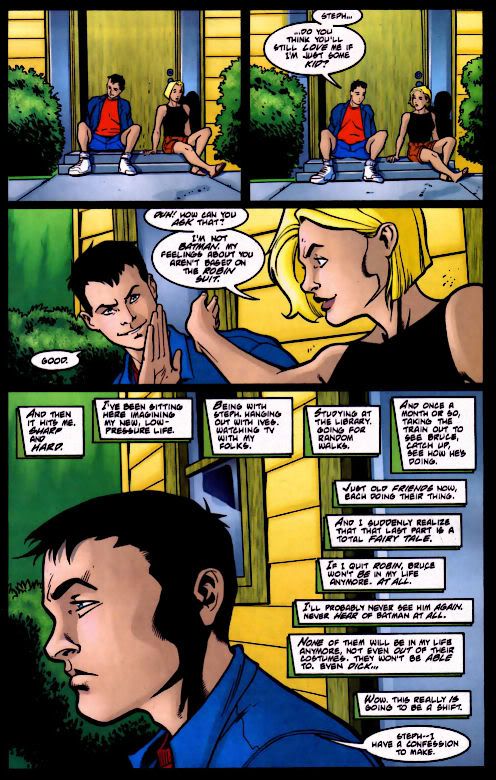
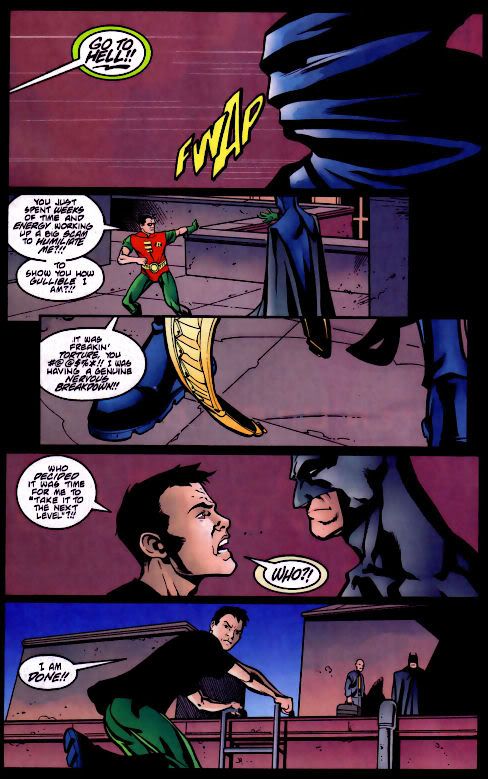
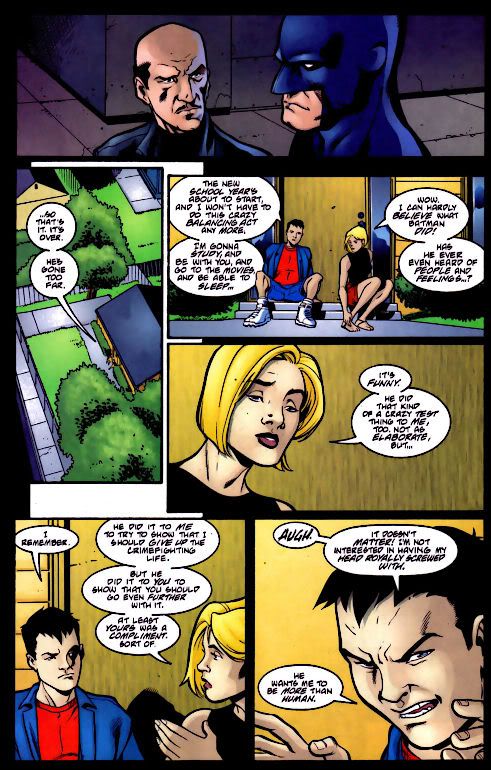
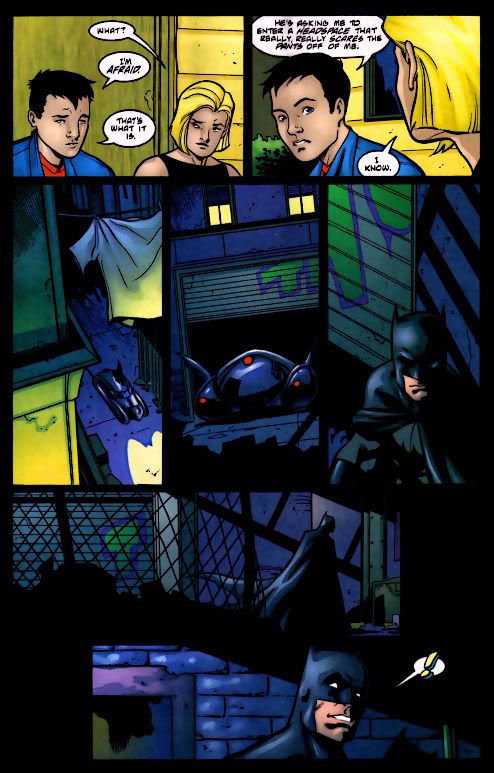
I could give a point-by-point analysis reason for the above statement, but I really don't have to. All I *have* to do is link you to this page from the aforementioned ROBIN #120. If any of you reading this post can actually *give* me a half-decent fanwank to explain how Steph and Tim got from there to... well, *anywhere* they were shown during Willingham's run? You win a cookie.
But before you try -- keep in mind that I *will* be able to counter your fanwank with pages from any number of different issues of different Batverse titles written by different *people*. Keep in mind that one of the truly remarkable things about Stephanie Brown as a character is that, before "War Games," her character's arc and identity *wasn't* hampered -- or snarled with conflicting canon -- by the fact that she was written by so very many wildly different writers.
Contrast that with Tim, dude.
And, well, again -- Willingham had a tough row to hoe. He was given a task even the most experienced writers of derivative fiction ("fan-fiction" doesn't seem like the most accurate term to use, but please -- *please* -- don't assume we're assigning a derogatory value judgment to the term "derivative fiction." As we define it, "fan-fiction" is just a sub-category to the broad and somewhat nebulous category *of* "derivative fiction, and most of DC's house writers earn their paychecks penning derivative fiction about characters created by other writers decades ago.) would find challenging.
It is, perhaps, not entirely surprising that he'd screw the pooch so thoroughly. However, the fact remains that the pooch has been walking funny since Willingham took over ROBIN, and the man has no right to complain if TPTB at DC do, in fact, take a good, long look at the way sales of the title have plummeted since ROBIN #125 and find some way to get rid of his ass... as both Jack and I (and probably most of you reading this) sincerely hope they will.
Basically, our Steph-related problems with "War Games" are two-fold. First and foremost, despite now having read months of post-"War Games" issues of various titles, Jack and I remain unconvinced of the dramatic usefulness of the storyline. Steph was, for a while, one of Babs' Birds, and one of *Dinah's* students. How did her death impact on them? I haven't been reading Winick's "Under the Hood" for, well, a lot of reasons, but unless I just haven't been spoiled thoroughly enough, BATMAN hasn't given us anything to help put Steph's death into context since Gabrych's #634. Lieberman's doing his own Hush-thing in GOTHAM KNIGHTS. Johns? Does he even know that it wasn't *just* his father who Tim recently lost? Gabrych's BATGIRL is, at this point, the only title which *does* seem to be doing anything with Steph's death.
In all honesty, Jack and I are *confused* by Steph's death -- and Orpheus', too, but we're both still too pissed to actually write that rant -- because whether or not we, as fans, believe that a given death makes sense, or even that a given death is written *well*, it's actually far more rare *not* to get post-death storylines which -- at the very *least* -- take the opportunity to wallow in the angst.
Whether it was Donna's death in GRADUATION DAY, Ollie's death back in the last GREEN ARROW series, or any of a half-dozen others we could name, a character's death tends to be *used*.
The other problem is, well, everything else we've discussed in this post. Because yes, Willingham's assignment *was* a difficult one, but it wasn't an impossible one. Hell, we may not know *why* Lewis wrote "A Boy and His Mask" (how I'd love to *talk* to the man about it!), but we do know he wrote it, and...
Well, maybe it's just me. Maybe I'm *just* that obsessive a Tim -- and ROBIN -- fangirl. Maybe it *isn't* as obvious to anyone else as it is to me and Jack that that storyline could have been used as a prequel to a storyline in which Tim eventually quit, Steph took over being Robin, and, after one in-character thing or another, Steph wound up dead.
But I really don't think so.
Really.
In the end, Jack and I actually aren't sure whether or not we consider Steph's fate to be proof of misogyny, as opposed to just a pathetic litany of poor editorial decisions foisted on a writer who didn't have the chops to make a good story out of a sow's ear. Would it have gone differently if Spoiler had been, say, Tim's problematic male best friend, as opposed to his girlfriend?
Would it have gone differently if Tim's character arc hasn't been so unique in terms of the fact that the males in his life have pretty much always been fellow *approved* superheroes? A case could be made, I suppose, that it's problematic that Steph was always presented as *being* problematic, as being not good *enough*, but it'd be a weak one -- there *is* no sub-universe in the DCU with more eminently competent and bad-ass female characters than the Batverse, and there are quite a few reasons why the parallels between Steph and Jason have always run fast and furious.4
A part of me wonders if this whole Steph *thing* couldn't be read as just the *bad* writer flipside to something like IDENTITY CRISIS. After all, no one can argue that female characters *don't* get shafted in IC. It's just that -- for those of us who *did* enjoy DC's Twenty-Eight Dollar Adventure -- that wasn't the point.
The writing was just too good, the meta too brilliant, the thought and *care* Meltzer put into his story too undeniable.
And, you know, I actually *have* outlined an alternate version of "War Games" in which the only thing I changed was to pretend that Lewis had never left ROBIN, and that "A Boy and His Mask" was, in fact, the real prequel to "War Games." I honestly believe that it would've been entirely possible to have everything which happened canonically *happen* -- and still wind up with a story which is 100% true to the characters in question. (Yes, I *am* that obsessive.) What *that* means to me is that it's possible that there's nothing more inherently wrong with "War Games" than there was with, well, IDENTITY CRISIS.
And while *that* leads us inexorably into the land of subjective fan-on-fan arguments, I think it's fair to say that far more of us *did* enjoy IC as a whole than enjoyed WG. And since I *do* tend to trust the opinions of my fellow fen (in this corner of comics fandom, anyway) more often than I don't... I can't help but think that that *means* something, however small.
In the *end*... I remain conflicted, and angry, and sad. Steph deserved one whole *hell* of a lot better than she got --
And so did we.
*
1. Bernard, when he was introduced, was really the character Te would've voted 'Most Likely To Make Te Give Willingham's Abilities As A Writer -- As Opposed To As A Writer Of Derivative Fiction -- The Benefit of the Doubt.' Sparky, interesting, appealing on a number of levels -- *and* a genuinely new addition to the background of the ROBIN universe. However, the fact of the matter is that, despite the fact that Willingham is the *only* writer to do anything with the boy thus far, Bernard still doesn't actually have one consistent characterization. He's not as inconsistent as, say, S6 Scully on X-Files, but there's simply no telling whether he'll be presented as a baby Carson (Queer Eye) or a generic idiot fratboy, or as whatever else Willingham decides he'll need to be this month.
2. While Te chose to use the archaic, three-syllable spelling of Willinghamfucktard's name, frequent -- or even occasional -- readers of this journal will have noted Jack habitually goes with the current Willinghamfucktard spelling inspired by the man's own work.
3. We should state for the record that we, personally, found the vast majority of the individual "War Games" issues quite entertaining. (And as Jack discovered while writing Parallel Imperatives, even the worst of the individual issues -- i.e. Willingham's BATMAN #633 -- contained elements worth redeeming.) It's only when one tries to view the storyline as a coherent whole that the ability to be anything but critical is lost. This is something we find interesting, really, as it's often the other way around. ("Knightfall," "No Man's Land," etc.)
4. We must again state for the record that the conception of Jason as "the bad/unworthy/useless/whatever Robin" is pretty much all retcon, and that we really do believe that this is something which becomes fairly obvious to anyone who actually takes the time -- and suffers the old-school bad crack PAIN -- of reading his original arc. However, despite the efforts of writers like Loeb, Robinson, and, to a lesser extent, Dixon, that retcon remains nearly inescapable to this day.
*take a moment to eye Winick very darkly, indeed*
In any event, what *this* means is that the similarities between Steph and Jason are just as inescapable. The retcon of Jason Todd into "the morally questionable and not-good-enough Robin" means that we have just as much metatext to use for comparison of the two characters as we have text and subtext.
Some more meta by Jack (and others)
A ton more meta by Te (and others)
This is Te typing, but it's really a fully collaborative meta. It's just that I'm on the computer, and Jack is chillin' with comics about eight feet behind me, and really -- I'll be linking this from my LJ soon enough.
So, Jack and I were chatting about various yummy meta things currently floating around (notably this post from
beeblebabe and this particular thread in the comments), musing on the nature of the female voice (and lack thereof) in comics, and how the Women In Refrigerators site really *had* to get that name. Not just for the recognizability aspects, but for the fact that the infamous (and eponymous) Alex storyline in GL -- and the way Marz himself talks about it -- really *highlights* one of the biggest problems with the way women are used in a lot of comics.
Marz:
All that said, I can tell you Alex was a character destined to die from the moment she was first introduced in GL #48. I created her with the intention of having her be murdered at the hands of Major Force. I took a lot of care in building her as a character, because I wanted her to be liked and her death to mean something to the readers. I wanted readers to be horrified at the crime, and to empathize with Kyle's loss. Her death was meant to bring brutal realization to Kyle that being GL wasn't fun and games. It was also meant to sever his links with his old life, paving the way for his move to New York. And ultimately I wanted her death to be memorable and illustrate just how truly heinous Major Force was. Thus the fridge.
Now, I've talked about this quote a lot over the past several months, and how it pretty much drives me batshit insane, but some things bear repeating. Because really, what Marz is saying here is that Alex wasn't just born to die, but that she was born to die *solely for the purpose* of advancing the character arcs of two male characters. She's there to make us go all woobie-eyed for Kyle and get a nice big hate-on for Major Force. That's just fact.
Less factual is... well. I've *read* a goodly number of Marz's GL issues (hey, I have to have *reason* before I put a writer on my "oh, HELL no" list), and Jack has read a fair if smaller number, and the thing is? Considering the canon and the interviews, it simply isn't beyond the realm of possibility for readers like us to take one look at that quote about the heinousness of Major Force and wonder if we're supposed to hate him because he's a brutal killer or, you know, because he made poor Kyle cry. But that's an aside.
Basically, what we have here is textbook Lingering/Underlying Misogyny. Women who exist not to be characters in their own right -- and certainly not to be *people* -- but to be plot devices.
And this all brought the two of us back to the "War Games" bitterness, because really... Alex died years ago, and the hoopla that exploded over the world of comics after that event went public was over long before most of the people reading *this* post ever picked up a DC comic. It's just that certain people clearly haven't learned anything from it.
Back it up a little bit. We all know how it goes when a character dies in comics, right? Usually, it's someone who, for whatever reason, hasn't gotten to star in any titles for a while. Someone whose last major storyline occurred years before, etc. That character gets a few issues of whichever title(s) are getting the Capital-E-Event in which to shine, garner our sympathies, and wander around having doom-laden conversations with the characters who'll actually survive the violence.
After all -- we, as readers, must be given as many opportunities as possible to think back to the issues before the death in question and think "aw, man, [Surviving Character] will *never* forget that! WOOBIE!"
This is routine. This is how it *goes*.
It's illustrated beautifully in "War Games" with Orpheus. We may never know *why* the guy got shoved into limbo after being introduced in ORPHEUS RISING. (Before Gabrych reintroduces him in DetC, we get to see him hanging out with Dinah in BATMAN: FAMILY and getting blown off by Nightwing during "Murderer." That's... it.) Most people who read War Drums (the trade collecting the DETECTIVE COMICS and ROBIN issues which lead up to "War Games" proper) had never even heard of the guy, but Gabrych played his part in this neverending dance of character death quite well.
Readers got to see him, hang out with him, watch him fight crime, watch him be cute with Onyx, watch him interact with Batman -- the whole nine yards. While we probably could've gotten a few more woobie moments in before they offed his ass, well... I'm pretty glad we didn't, because it would've just pissed me off that much more.
Anyway, Orpheus.
"War Games" also illustrates one of the standard *alternate* routes to character death, in which a *new* character is introduced solely to interact with one of the major characters for *just* long enough to make his/her death "meaningful" when it eventually happens. Witness Darla Aquista, friends and neighbors. While we *didn't* immediately guess that her ass was doomed, in retrospect? We probably should have.
Most of us ignored Darla as much as we could while Willingham did his "best" to introduce her as Tim's new love interest and as the *other* character with whom Tim could bond during his exile from vigilantism. After all, we've *also* all been through the "new writer comes on and deletes the old supporting cast/introduces a new one" dance. As a result, most of us tend to need a bit of time -- or a truly *standout* new character -- before we get on board with the new regime. With Darla Aquista (as opposed to with Bernard1), Willingham2 gave us neither.
I'm pretty sure Jack and I weren't alone when we assumed that she'd be around *just* to be the new love interest, you know? In any event, her *real* role was revealed soon enough. While ROBIN #129 was actually a very enjoyable issue, full stop, it's also the issue in which we were expected to believe that it was *Darla* being in danger which makes Tim let his
However, it was neither Orpheus nor Darla who got Jack and me thinking tonight -- it was *Steph*. Because, really, Steph doesn't actually fit within these standard roles/scenarios at all, when you think about it for a while.
Hell, when you think about it for more than a few *seconds*.
Steph was created by Chuck Dixon twelve years ago, and while she was never the star of any of the titles, she had major roles and storylines in DETECTIVE COMICS, BATMAN, BATGIRL, GOTHAM KNIGHTS, BIRDS OF PREY, and, of course, ROBIN. Hell, she got respectable screentime in YOUNG JUSTICE, of all places -- which is pretty impressive, considering the fact that neither Bart, Cassie, nor Kon got any interaction with her.
Think about that for a minute, and about the fact that writers from Grayson to Rucka to Puckett to Lewis to Beatty to David *all* wrote stories with this character, and about the fact that *this* means Steph was never actually *in* limbo.
Hell, go back to ROBIN #120, the last issue in the last storyline before Willingham took over. Where's Steph? Well, she's right *there*. As a matter of fact, it's eminently arguable that Steph was never *more* present within general Batverse continuity (and Tim's specific day-to-day life) than she was during the just under two years of Lewis' run on the title.
By rights, this should really have exempted her from the list of characters potentially on the literal and figurative chopping block, but it didn't. Well, go with that. Shouldn't I think it's cooler that she wasn't exempted? Shouldn't I be impressed with the bravery of the storytelling?
Well, *shouldn't* I?
Fuck *no*, I shouldn't, and here's why: Willingham's Steph, while not as wildly (and bizarrely) out of character as Willingham's Tim, Bruce, Alfred, and Babs, certainly bore only the vaguest resemblance to the girl we'd been reading about for the past twelve years. (In all honesty, I wouldn't be surprised if the *only* reason why Steph wasn't as unrecognizable as the others was the fact that she was always supposed to be some degree of "normal" and "average." This? Is not altogether difficult to fake, even for a person who clearly hadn't read *anything* which had come before for the characters in question.)
We know now that Willingham was given a rather specific -- and unenviable -- assignment when he came onto ROBIN. We know that, whatever else he did, he had to a) get Tim out of the suit, b) get Steph *into* the suit, and c) help set up the "War Games" storyline which would d) end with Steph's death. It isn't *his* fault that those things happened, by all reports.
What *is* his fault -- and what I, personally, will never forgive his arrogant, crap-writing ass for -- is the *way* he went about these things. In terms of Steph in particular: Instead of even making a half-assed attempt to try to get her from Lewis' point A to DC Editorial's point B, there really isn't much difference between the way he treated Steph and the way he treated Darla.
Steph might as well have *been* a new and born-to-die character for all the acknowledgment we received about her long-standing relationships with the other characters in the Batverse -- *including* Tim, the boy she'd been dating for two years of comics time and about a decade of our time.
I could give a point-by-point analysis reason for the above statement, but I really don't have to. All I *have* to do is link you to this page from the aforementioned ROBIN #120. If any of you reading this post can actually *give* me a half-decent fanwank to explain how Steph and Tim got from there to... well, *anywhere* they were shown during Willingham's run? You win a cookie.
But before you try -- keep in mind that I *will* be able to counter your fanwank with pages from any number of different issues of different Batverse titles written by different *people*. Keep in mind that one of the truly remarkable things about Stephanie Brown as a character is that, before "War Games," her character's arc and identity *wasn't* hampered -- or snarled with conflicting canon -- by the fact that she was written by so very many wildly different writers.
Contrast that with Tim, dude.
And, well, again -- Willingham had a tough row to hoe. He was given a task even the most experienced writers of derivative fiction ("fan-fiction" doesn't seem like the most accurate term to use, but please -- *please* -- don't assume we're assigning a derogatory value judgment to the term "derivative fiction." As we define it, "fan-fiction" is just a sub-category to the broad and somewhat nebulous category *of* "derivative fiction, and most of DC's house writers earn their paychecks penning derivative fiction about characters created by other writers decades ago.) would find challenging.
It is, perhaps, not entirely surprising that he'd screw the pooch so thoroughly. However, the fact remains that the pooch has been walking funny since Willingham took over ROBIN, and the man has no right to complain if TPTB at DC do, in fact, take a good, long look at the way sales of the title have plummeted since ROBIN #125 and find some way to get rid of his ass... as both Jack and I (and probably most of you reading this) sincerely hope they will.
Basically, our Steph-related problems with "War Games" are two-fold. First and foremost, despite now having read months of post-"War Games" issues of various titles, Jack and I remain unconvinced of the dramatic usefulness of the storyline. Steph was, for a while, one of Babs' Birds, and one of *Dinah's* students. How did her death impact on them? I haven't been reading Winick's "Under the Hood" for, well, a lot of reasons, but unless I just haven't been spoiled thoroughly enough, BATMAN hasn't given us anything to help put Steph's death into context since Gabrych's #634. Lieberman's doing his own Hush-thing in GOTHAM KNIGHTS. Johns? Does he even know that it wasn't *just* his father who Tim recently lost? Gabrych's BATGIRL is, at this point, the only title which *does* seem to be doing anything with Steph's death.
In all honesty, Jack and I are *confused* by Steph's death -- and Orpheus', too, but we're both still too pissed to actually write that rant -- because whether or not we, as fans, believe that a given death makes sense, or even that a given death is written *well*, it's actually far more rare *not* to get post-death storylines which -- at the very *least* -- take the opportunity to wallow in the angst.
Whether it was Donna's death in GRADUATION DAY, Ollie's death back in the last GREEN ARROW series, or any of a half-dozen others we could name, a character's death tends to be *used*.
The other problem is, well, everything else we've discussed in this post. Because yes, Willingham's assignment *was* a difficult one, but it wasn't an impossible one. Hell, we may not know *why* Lewis wrote "A Boy and His Mask" (how I'd love to *talk* to the man about it!), but we do know he wrote it, and...
Well, maybe it's just me. Maybe I'm *just* that obsessive a Tim -- and ROBIN -- fangirl. Maybe it *isn't* as obvious to anyone else as it is to me and Jack that that storyline could have been used as a prequel to a storyline in which Tim eventually quit, Steph took over being Robin, and, after one in-character thing or another, Steph wound up dead.
But I really don't think so.
Really.
In the end, Jack and I actually aren't sure whether or not we consider Steph's fate to be proof of misogyny, as opposed to just a pathetic litany of poor editorial decisions foisted on a writer who didn't have the chops to make a good story out of a sow's ear. Would it have gone differently if Spoiler had been, say, Tim's problematic male best friend, as opposed to his girlfriend?
Would it have gone differently if Tim's character arc hasn't been so unique in terms of the fact that the males in his life have pretty much always been fellow *approved* superheroes? A case could be made, I suppose, that it's problematic that Steph was always presented as *being* problematic, as being not good *enough*, but it'd be a weak one -- there *is* no sub-universe in the DCU with more eminently competent and bad-ass female characters than the Batverse, and there are quite a few reasons why the parallels between Steph and Jason have always run fast and furious.4
A part of me wonders if this whole Steph *thing* couldn't be read as just the *bad* writer flipside to something like IDENTITY CRISIS. After all, no one can argue that female characters *don't* get shafted in IC. It's just that -- for those of us who *did* enjoy DC's Twenty-Eight Dollar Adventure -- that wasn't the point.
The writing was just too good, the meta too brilliant, the thought and *care* Meltzer put into his story too undeniable.
And, you know, I actually *have* outlined an alternate version of "War Games" in which the only thing I changed was to pretend that Lewis had never left ROBIN, and that "A Boy and His Mask" was, in fact, the real prequel to "War Games." I honestly believe that it would've been entirely possible to have everything which happened canonically *happen* -- and still wind up with a story which is 100% true to the characters in question. (Yes, I *am* that obsessive.) What *that* means to me is that it's possible that there's nothing more inherently wrong with "War Games" than there was with, well, IDENTITY CRISIS.
And while *that* leads us inexorably into the land of subjective fan-on-fan arguments, I think it's fair to say that far more of us *did* enjoy IC as a whole than enjoyed WG. And since I *do* tend to trust the opinions of my fellow fen (in this corner of comics fandom, anyway) more often than I don't... I can't help but think that that *means* something, however small.
In the *end*... I remain conflicted, and angry, and sad. Steph deserved one whole *hell* of a lot better than she got --
And so did we.
*
1. Bernard, when he was introduced, was really the character Te would've voted 'Most Likely To Make Te Give Willingham's Abilities As A Writer -- As Opposed To As A Writer Of Derivative Fiction -- The Benefit of the Doubt.' Sparky, interesting, appealing on a number of levels -- *and* a genuinely new addition to the background of the ROBIN universe. However, the fact of the matter is that, despite the fact that Willingham is the *only* writer to do anything with the boy thus far, Bernard still doesn't actually have one consistent characterization. He's not as inconsistent as, say, S6 Scully on X-Files, but there's simply no telling whether he'll be presented as a baby Carson (Queer Eye) or a generic idiot fratboy, or as whatever else Willingham decides he'll need to be this month.
2. While Te chose to use the archaic, three-syllable spelling of Willinghamfucktard's name, frequent -- or even occasional -- readers of this journal will have noted Jack habitually goes with the current Willinghamfucktard spelling inspired by the man's own work.
3. We should state for the record that we, personally, found the vast majority of the individual "War Games" issues quite entertaining. (And as Jack discovered while writing Parallel Imperatives, even the worst of the individual issues -- i.e. Willingham's BATMAN #633 -- contained elements worth redeeming.) It's only when one tries to view the storyline as a coherent whole that the ability to be anything but critical is lost. This is something we find interesting, really, as it's often the other way around. ("Knightfall," "No Man's Land," etc.)
4. We must again state for the record that the conception of Jason as "the bad/unworthy/useless/whatever Robin" is pretty much all retcon, and that we really do believe that this is something which becomes fairly obvious to anyone who actually takes the time -- and suffers the old-school bad crack PAIN -- of reading his original arc. However, despite the efforts of writers like Loeb, Robinson, and, to a lesser extent, Dixon, that retcon remains nearly inescapable to this day.
*take a moment to eye Winick very darkly, indeed*
In any event, what *this* means is that the similarities between Steph and Jason are just as inescapable. The retcon of Jason Todd into "the morally questionable and not-good-enough Robin" means that we have just as much metatext to use for comparison of the two characters as we have text and subtext.
Some more meta by Jack (and others)
A ton more meta by Te (and others)


![[identity profile]](https://www.dreamwidth.org/img/silk/identity/openid.png)
no subject
Date: 2005-04-06 12:09 am (UTC)*nods* You're absolutely right. And, well, to a certain extent? That *is* what's happening here, too. While Jack Drake's death is overshadowing Steph's -- and it *is* notable that this is happening with the more minor character -- Steph's death is overshadowing *Gavin's*. (Orpheus') I mean, fuck a *duck*. If you hadn't read "War Drums," "War Games," and Batman #634, you'd have no idea that he was (still) working in Gotham, never mind having any idea that he'd been murdered and had his body desecrated in the process.
(rage... rage... rage...)
In any event, all this means is that DC is doing a bang-up job at fucking up character death storylines. Because, well, why only shaft *one* dead hero when you can shaft *two*?
Is there a reason why they decided to kill Steph off and then pretend she never existed?
Heh. Excellent question.
[Honestly, the lack of commentary wrt Steph's death, the current events as of Batman #638, and the events of DC Countdown are starting to make me wonder if we've stepped into some strange alternate reality DCU where, you know, so-and-so didn't die, and so-and-so never became a superhero and such-and-such was never evil/discovered to be evil, or whatever. But that's just me fanwanking things so I don't sit around going "Bzuh?" I think.]
The part of me which is still naively optimistic about this fandom on a metatextual level is pointing out that Outsiders #21 (#20? I can't remember offhand), with that Bruce-Dick conversation of Meta + Ominous Foreshadowing (the case, the files with Two-Face *and* Killer Croc up on the screen) suggests that your fanwank just *might* not be entirely off-the-wall.
And then the realist in me points to Batman #638, and I just throw up my hands. *sigh*